


Peptide Pen vs Vial: What the Format Actually Changes, Including the Excipient Nobody Puts on the Product Page
We stock seventeen peptides in preloaded pens and I have spent a while being uncomfortable that nobody in this industry explains what the format does. It is sold on convenience: no mixing, no bacteriostatic water, no syringe. All true. What none of it mentions is that a multi-dose pen almost certainly contains an antimicrobial preservative, that preservatives are known to destabilise peptides, and that for anyone running cell-based work the preservative is a bigger problem than the convenience is a benefit.
Research-use-only disclaimer: Peptides supplied by PrymaLab in any format, including preloaded autoinjectors, are intended strictly for in-vitro and laboratory research use and are not intended for human or veterinary use. This article compares physical formats and formulation chemistry. It contains no dosing or administration guidance and nothing here is medical advice.

TL;DR
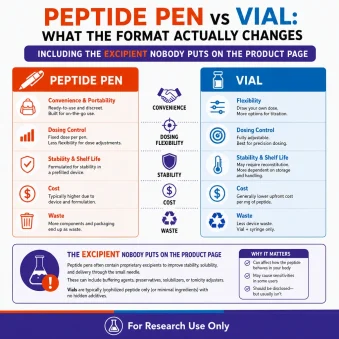
The difference is state of matter, not the needle. A vial holds lyophilised powder; a pen holds peptide already in solution. Three things follow. The stability clock starts at the factory rather than at your bench, because the reactions that destroy peptides need water. A multi-dose pen needs an antimicrobial preservative, typically metacresol, phenol or benzyl alcohol, which powder does not, and preservatives generally destabilise proteins and promote aggregation. And the concentration is fixed by whoever filled it. For consistency across sessions, the pen wins. For cell-based in-vitro work the pen is usually the wrong choice, because you are adding a compound chosen for how well it kills cells alongside the compound you are studying. Research use only.
The real difference: powder versus solution. Everything else follows.
Shelf life: a pen has been in solution since it was filled.
Preservative: multi-dose pens need one. Powder does not.
Preservatives are not inert. They generally promote aggregation.
Metacresol and phenol interact near tryptophan. Benzyl alcohol did not, in the same comparison.
Cell culture: use powder. The preservative is cytotoxic by design.
Status: research use only.
The Difference Is Not the Needle
Most explanations of this format start with the delivery mechanism, which is the least interesting part. A pen has a spring and a dose dial. Fine.
The difference that matters is what physical state the peptide is in when it arrives.
A conventional vial contains lyophilised powder, freeze-dried, with the water removed. You add a diluent when you are ready to use it.
A preloaded pen contains peptide in solution, dissolved at the manufacturer, filled into a cartridge, sealed behind a septum.
Everything else about the comparison falls out of that one difference. Shelf life, excipients, concentration flexibility, transport requirements, what your certificate of analysis is describing. If you hold that one fact you can derive the rest of this article yourself, and most of the format's marketing does not mention it at all.
The Stability Clock Starts at the Factory
Peptides in the dry state are comparatively stable. Peptides in solution are not, and the reason is that the reactions destroying them mostly require water.
Our storage and stability reference covers the four chemistries in detail: oxidation, deamidation, hydrolysis and aggregation. Hydrolysis needs water by definition. Deamidation proceeds through a succinimide intermediate whose formation and resolution both involve water. Aggregation depends on molecular mobility, and lyophilisation restricts mobility severely.
Which produces the point most people miss about the pen format:
This also reframes the convenience argument. "No reconstitution required" is often presented as removing a step. It removes the step by having already performed it, weeks or months before the product reached you, under conditions you did not observe.
I am not saying that is bad. Pharmaceutical manufacturers fill pens under controlled conditions far better than anyone's bench, and a professionally filled cartridge is more consistent than most hand reconstitutions. The point is that the step happened, and the clock has been running since it did.
The Excipient Nobody Puts on the Product Page
Here is the part I actually wanted to write about, and the reason this article exists.
A multi-dose container gets punctured repeatedly. Every puncture is an opportunity for microbial ingress, and a peptide solution held at refrigerator temperature for weeks is a reasonable growth medium. Pharmacopoeial requirements for multi-dose parenteral products therefore call for antimicrobial preservation.
The standard choices in peptide and protein pens are metacresol, phenol and benzyl alcohol. Insulin pens, growth hormone pens and the GLP-1 pens all carry one of these.
A single-use vial of lyophilised powder does not need any of them. There is no water for anything to grow in, and you puncture the stopper once.
So the pen contains something the vial does not, and that something is not chemically inert with respect to your peptide.
Antimicrobial preservatives generally destabilise proteins and promote aggregation, and this is a recognised constraint on the use of multi-dose protein formulations rather than a fringe concern.[1] It is one of the reasons a great many biologics are supplied as single-use presentations despite the obvious convenience advantages of multi-dose ones.
I have never seen this on a peptide autoinjector product page. Including, until now, ours.
Which Preservative, and Why the Sequence Decides
The three common preservatives do not behave identically, and the difference maps onto amino acid content in a way that fits the pattern running through this whole library.
In a direct comparison of antimicrobial excipients in parenteral peptide formulations, metacresol and phenol interacted with the peptide specifically. Both increased hydrophobicity near the tryptophan residue and induced conformational change.[1]
Benzyl alcohol did not. In the same work it produced no change in tryptophan fluorescence, no measurable interaction enthalpy and no conformational change.[1]
Tryptophan. Again.
Readers of the storage reference will recognise the residue, because it is the same one that absorbs ultraviolet light and generates reactive species that go on to attack methionine and cysteine. Tryptophan is the aromatic residue that keeps turning out to be where things happen, and now it is the residue that metacresol docks against.
The consequence is that preservative compatibility is sequence-dependent, exactly like storage stability. A peptide with no tryptophan has no site for that particular interaction. A peptide carrying tryptophan in an exposed position has one.
Run that across a catalogue and the answers differ compound by compound. BPC-157 is GEPPPGKPADDAGLV, no aromatic residues at all, so the metacresol interaction described above has nothing to bind. Semax carries phenylalanine but not tryptophan. Others do carry tryptophan.
Benzyl alcohol is not a free pass either. It has been reported to worsen freeze-thaw-induced aggregation of trastuzumab, with 1.1 percent identified as an optimal concentration providing adequate preservation while reducing that risk relative to 2 percent.[2] So the choice is which trade you prefer rather than whether there is one.
Why This Rules Pens Out for Most Cell Work
Everything above is a stability argument. This one is a validity argument and it is the practical conclusion of the article.
An antimicrobial preservative is in the formulation because it kills microorganisms. It is not selectively toxic to bacteria in the way an antibiotic is. Metacresol, phenol and benzyl alcohol are general-purpose antimicrobials that work by disrupting membranes and denaturing proteins, and at the concentrations used in parenteral formulations they are toxic to mammalian cells too.
So consider what happens when preserved pen solution goes into a cell-based assay. You have added the compound under study, and alongside it a cytotoxic excipient at a concentration chosen to kill things.
Two failure modes follow, and they point in opposite directions, which is what makes this genuinely bad rather than merely inconvenient:
- A false negative. Preservative toxicity suppresses the readout, and a compound that does something looks like it does nothing.
- A false positive. If the endpoint is anything to do with cell stress, membrane integrity, apoptosis or viability, the preservative produces the effect and the compound gets the credit.
A vehicle control containing preservative at matched concentration handles this properly. My honest observation is that people running informal in-vitro work frequently do not run that control, because the excipient is not on the label they read.
For cell-based work, buy the powder. Reconstitute in a diluent you selected, at a concentration you chose, with no antimicrobial in it. The convenience of the pen is worth nothing if it compromises the assay, and the pen was designed for repeated parenteral dosing rather than for pipetting into a plate.
Fixed Concentration, Gained and Lost
A pen is filled at one concentration. Our autoinjectors run from 1mg/mL for the IGF-1 analogues up to 500mg/mL for the higher-strength NAD+ presentation, and each one is what it is.
What you gain is the elimination of reconstitution variance. Hand reconstitution introduces error from diluent volume measurement, incomplete dissolution, adsorption losses to the vial wall, and operator-to-operator differences. Across a long study with several people handling material, that variance is real and it is invisible unless someone assays for it.
What you lose is the choice of concentration. With powder you choose the diluent volume and therefore the concentration, which matters when a protocol calls for a specific one or when the working volume is constrained.
Which of those dominates depends entirely on the work. Repeated identical conditions over months favour the pen. Concentration-response work across a range favours powder, obviously, since you need multiple concentrations and the pen gives you one.
The Arithmetic People Get Wrong
This one is not chemistry, it is multiplication, and I see it go wrong constantly when people compare prices across formats.
A vial is labelled by total mass. A 5mg vial contains 5mg of peptide.
A pen is labelled by concentration and volume. A 3mL pen at 5mg/mL contains 15mg.
So "the 5mg pen" and "the 5mg vial" are not comparable quantities, and anyone dividing price by the number on the label is comparing three units of one thing against one unit of another. Our KLOW autoinjector at 80mg/mL in a 3mL cartridge holds 240mg of blend. The 80mg vial holds 80mg.
Two caveats that pull the other way, which is why I am not presenting this as a straightforward win for the pen.
The first is that total mass is not usable mass. Pens retain a residual volume in the cartridge that cannot be expelled, and there is priming loss at each use if the device requires it. Neither is large, but neither is zero, and they scale with how many separate withdrawals you make.
The second is that the mass in a pen is on a clock. Fifteen milligrams of solution you must use before a date is worth less than fifteen milligrams of powder you can keep for a year and reconstitute in portions. If the work will not consume the cartridge inside its dating, the extra mass is theoretical.
The Same Argument Applies to Nasal Sprays
Everything above about preservatives transfers to nasal sprays, and the preservative involved is different and worse understood by most buyers.
A nasal spray bottle is a multi-dose aqueous container that is opened repeatedly, so it needs antimicrobial preservation for the same reason a pen does. The standard choice in nasal formulations is not metacresol, it is benzalkonium chloride, a quaternary ammonium compound.
Benzalkonium chloride has a well-documented problem specific to this route: it is toxic to nasal epithelial cells and impairs ciliary function, which is the mechanism by which the nasal mucosa clears itself.
Why that matters for a research question rather than for comfort: if you are studying intranasal delivery, the preservative is acting on the exact tissue that governs absorption. Ciliary clearance rate determines how long a formulation sits on the mucosa before being swept to the pharynx and swallowed. A preservative that slows or damages ciliary function changes residence time, which changes absorption, which is the variable most intranasal studies are actually measuring.
So a preserved nasal formulation is not a neutral vehicle for studying nasal absorption. It is a vehicle that perturbs the clearance mechanism. Whether that biases results upward, by extending residence time, or downward, by damaging the epithelium, is not something I can tell you from the general literature, and I have not found work that resolves it for peptides specifically.
The intranasal route in general, including why it appeals for peptides that cannot survive other routes, is covered in our intranasal delivery reference. The preservative question is the part that article does not address and this one does.
Metering Precision Is Not Dose Accuracy
A short section on a distinction that gets collapsed constantly.
A pen mechanism meters volume in fixed increments. That is mechanically repeatable and better than reading graduations on a syringe barrel by eye, particularly at small volumes where syringe error is proportionally largest.
Delivered mass is volume multiplied by concentration. So metering precision only converts into dose accuracy if the solution is actually at its stated concentration.
A pen that has lost potency to aggregation delivers its nominal volume perfectly and the wrong amount of intact peptide. The mechanism has no way to know and no way to tell you. Precision and accuracy are different properties and the pen format improves one of them.
Cold Chain and Transit
Solutions need refrigeration. Lyophilised powder tolerates ambient excursions that would matter for a solution, which is why powder ships more forgivingly and why almost every long-distance research peptide shipment is powder.
The transit question I would ask about any pen is what happened between the filling line and your refrigerator, and whether anyone was measuring. A shipment that spent two days warm has consumed shelf life that the printed date does not know about.
Freezing is the other end and it is worse for pens than most people assume. Freeze-thaw is a recognised aggregation trigger, the benzyl alcohol interaction above makes it worse, and a cartridge that froze in transit and thawed before arrival looks completely normal.
There is a compounding effect here that the two hazards produce together and neither produces alone. Aggregation is largely irreversible, so a cartridge that froze once carries that damage for the rest of its life, and every subsequent warm period acts on a solution that already contains aggregate. Aggregates seed further aggregation, so the damage is not additive across insults, it accelerates. A pen that had one bad night in a delivery van and then sat correctly refrigerated for two months is not in the same condition as a pen that was cold the whole way, and nothing on the outside distinguishes them.
Powder does not behave this way, which is the practical reason the format matters more for long shipments than for anything else in this article. A vial that got warm in transit and then went into a fridge is, to a reasonable approximation, fine. The reactions that would have damaged it needed water that was not there.
What a Pen Certificate Should Describe
The same question as for capsules in the oral versus injection reference, and the answer is wrong about as often.
Does the certificate describe the finished filled pen solution, or the raw peptide before it was dissolved and filled?
The second is much more common and much less useful. Testing powder before filling tells you what went in. It does not tell you what the solution looked like after dissolution, preservative addition, filling and however long the finished cartridge sat at the manufacturer's storage temperature before shipping. Every process step in that list is a place where a purity figure can move.
At PrymaLab, research peptides are characterised with HPLC and mass spectrometry verification and independent third-party testing.
Side by Side
| Preloaded pen | Lyophilised vial | |
|---|---|---|
| Physical state on arrival | Solution | Powder |
| Degradation clock started | At filling | At your reconstitution |
| Antimicrobial preservative | Yes, if multi-dose | No |
| Concentration | Fixed by manufacturer | You choose |
| Reconstitution variance | None | Operator-dependent |
| Suitable for cell culture | Usually no | Yes |
| Transit tolerance | Poor, cold chain | Good |
| Volume metering | Fixed increments | Syringe graduations |
Choosing Between Them
Reduced to the decision rather than the chemistry.
Powder, if the work is cell-based or the endpoint touches viability or membrane integrity; if you need more than one concentration; if the material has to travel a long way or sit for a long time before use; or if you want a certificate that describes exactly the thing you will handle.
Pen, if the priority is identical conditions repeated over a long period with several operators, and the assay is not cell-based. The removal of reconstitution variance is a real methodological gain and I do not want to talk anyone out of it.
Our pens are listed across the research peptide catalogue, and the same compounds are available as lyophilised powder in every case. That is deliberate. The format should follow the experiment.
What Research Has Not Established
No published study compares preserved pen presentations against lyophilised material for any of the specific research peptides we supply. The formulation literature cited here concerns therapeutic peptides and proteins generally, and extending it to a particular sequence is inference rather than measurement.
Preservative interaction is sequence-dependent, which means the metacresol and tryptophan finding does not transfer uniformly across a catalogue. It tells you where to look, not what you will find.
No stability-indicating data exists, as far as I know, for research-grade peptide autoinjectors from any supplier, which means shelf-life dating in this segment is generally inherited from convention rather than measured on the product.
What is well established: that solution-state peptides degrade faster than lyophilised ones, that multi-dose parenteral products require antimicrobial preservation, that preservatives generally destabilise proteins, and that metacresol and phenol interact near tryptophan while benzyl alcohol did not in the same comparison. Those are checkable.
Frequently Asked Questions
What is the difference between a peptide pen and a vial?
State of matter. A vial holds lyophilised powder you reconstitute; a pen holds peptide already in solution. Shelf life, excipients and concentration flexibility all follow from that.
Do peptide pens have a shorter shelf life than vials?
The clock starts earlier. Degradation reactions mostly need water, so a pen has been degrading since it was filled while powder has not started.
Do peptide pens contain preservatives?
Multi-dose pens generally require one, usually metacresol, phenol or benzyl alcohol, because the septum is punctured repeatedly. Lyophilised powder does not.
Can preservatives affect the peptide itself?
Yes. They generally destabilise proteins and promote aggregation. Metacresol and phenol increase hydrophobicity near tryptophan and induce conformational change; benzyl alcohol did not in the same comparison but worsens freeze-thaw aggregation.
Are peptide pens suitable for cell culture work?
Usually not. The preservative is cytotoxic by design, which can produce a false negative through suppression or a false positive if the endpoint involves viability or membrane integrity.
Does a fixed concentration matter?
It removes reconstitution variance, which helps consistency, and takes away your choice of concentration, which hurts concentration-response work.
What should a certificate of analysis for a pen describe?
The finished filled solution rather than the raw peptide before filling. Testing pre-fill powder tells you what went in, not what came out.
How much peptide is actually in a pen?
Concentration multiplied by fill volume. A 3mL cartridge at 5mg/mL holds 15mg, not 5mg. Comparing a "5mg pen" to a "5mg vial" on price compares three units against one.
Do nasal sprays have the same preservative problem?
Yes, with a different preservative. Nasal formulations typically use benzalkonium chloride, which is documented to impair ciliary function. Since ciliary clearance governs how long a formulation stays on the mucosa, a preserved spray perturbs the exact variable most intranasal absorption studies are measuring.
Is a pen more accurate than a syringe?
It is more precise at metering volume. Delivered mass still depends on the solution being at its stated concentration, so precision and accuracy are separate questions.
References
- Antimicrobial excipient-induced reversible association of therapeutic peptides in parenteral formulations. J Pharm Sci. ScienceDirect. Source for the general destabilising effect of preservatives on proteins, and for the metacresol and phenol interaction near tryptophan against benzyl alcohol's absence of effect.
- Benzyl alcohol exacerbates freeze-thaw-induced aggregation of trastuzumab: elucidating mechanisms and formulation implications for clinical practice. Int J Pharm. 2025. ScienceDirect. Source for the 1.1 percent against 2 percent benzyl alcohol finding.
- Pharmacopoeial antimicrobial effectiveness requirements for multi-dose parenteral preparations.
The formulation literature cited concerns therapeutic peptides and proteins generally rather than the specific research compounds discussed. Verify against the primary sources before relying on any of it for a particular sequence.
Final disclaimer: This article is an educational research reference. Peptides supplied by PrymaLab in any format are sold and studied for laboratory research use only and are not approved by any regulatory authority for human or veterinary use. Statements have not been evaluated by the FDA. Nothing here is medical advice, administration guidance, or a treatment claim.
Formulation findings described above come from studies of other peptides and proteins and may not generalise to any particular sequence. Always verify the legal status of any research compound in your jurisdiction before purchase or use.